Episode 61 Soul Sisters in Accounting: Megan Schwan on Profit, Boundaries & Building a Business That Works for You
- Samantha M. Besnoff, CPA

- Jun 4
- 8 min read
Updated: Aug 15
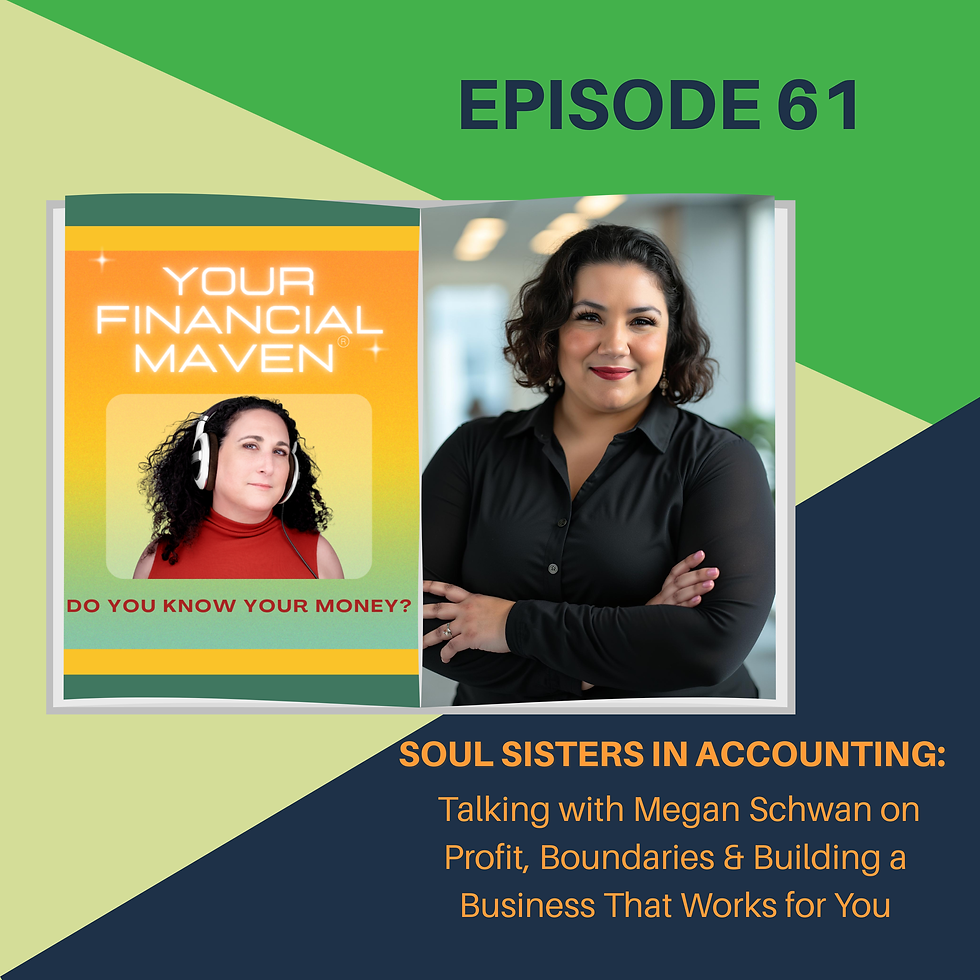
What does it actually take to move a small business from financial confusion to clarity and confidence? In this episode of Your Financial Maven®, I sat down with Megan Schwan, founder and CEO of Sidekick Accounting Services, a national virtual accounting firm on a mission to change the statistic that eight out of ten small businesses fail. Megan and I clicked immediately — two accountants of roughly twelve and thirteen years on our own, both moms, both beach lovers (she’s a “down the shore” girl too). I told her right away she felt like a soul sister, and this whole conversation has that warmth to it: practical, honest, and rooted in genuinely wanting small businesses to thrive.
Here are the highlights.
What Is Money?
I open every episode with the same question, no matter who’s in the guest chair — financial planner, business owner, or fellow CPA. Megan’s answer started where the textbook does: money is what we use to purchase goods and services, the dollar for us, but historically rocks, pebbles, sticks, even animals. I love asking this after three years of doing the podcast, because there’s never just one right answer. We know money is a medium of exchange — but it’s also so much more than that, and it’s worth stepping back to remember that.
From Teen Mom to CEO: Megan’s Story
Megan’s story starts before the business. She was a teen mom who took Accounting 101 in high school, and her teacher told her she had a knack for it. When she got pregnant and needed to figure out how to provide, she leaned into what she was good at — accounting was logical, it was a real career, and it stuck. She earned her bachelor’s, met her husband, worked full-time in a manufacturing company’s accounting department, then shifted to part-time bookkeeping at a landscaping company after her second son — her real intro to the small-business world. When she was laid off from two part-time jobs within a month of each other, she had to figure out what was next. She was already doing taxes and bookkeeping on the side, so she started networking, and — twelve years later — here she is.
That resonated with me. I’ll be celebrating thirteen years on my own this September, and I’ve been in accounting for over thirty years with my CPA license for twenty-five. But just like Megan, I fell in love with accounting in high school because of a business teacher whose passion for it made all the difference. He passed away a couple of years ago, and it still makes me sad — but those teachers truly do change lives.
The First Step Is Always the Same
When an overwhelmed entrepreneur comes to either of us, the very first question is the same: Do you have a separate business bank account? One hundred percent of the time, that’s where it starts. As business owners, we’re already overwhelmed — we’re selling, we’re making the product, we’re doing the work — and now we have to add the finances on top of it. Most owners don’t necessarily want to know that side; they want someone else to handle it. But they do need to understand it, and the first step is almost always that separate account.
“Knowing Your Numbers Has Nothing to Do With Being Good at Math”
This was my favorite thread of the whole conversation. So many owners say “I’m not good at math” or “I don’t know enough about this.” As Megan put it:
Knowing your numbers has nothing to do with you being good at math. It has everything to do with being a business owner.
If you want to be a successful business owner, you have to lean into your numbers, not shy away from them — and you’ll get where you’re going faster and more successfully if you do. It feels intimidating at first because a P&L or a balance sheet looks like random numbers. But once you start connecting your decisions to how those numbers move month to month, they become personal, tangible, and a lot less scary.
I get a version of this all the time too — “Oh, you must be a math major.” No. I can add, subtract, multiply, divide, and use a calculator. Knowing your numbers is really just understanding the money coming in and the money going out. I was actually at hand PT this week after thumb surgery, and the assistant said the same thing — “I don’t like math.” I looked at her and said, “You can add, right? That’s really all it is.”
What both Megan and I keep coming back to is grace. There’s no shame in not knowing this yet. So many people come to us having felt judged or talked down to, and that just blows my mind — because this part is so important for businesses, and it deserves a safe, judgment-free space.
Profit First: Flipping the Formula
Megan is a Certified Profit First Professional, and this was the heart of our conversation. I’ll be honest — I’ve read and listened to the Profit First methodology, I love it for small business owners, and I use a modified version myself. Megan explained it beautifully.
Profit First is a cash-flow management system, which is exactly why it works whether you’re struggling or successful — every good business runs on systems. Here’s the core idea: instead of the traditional formula of income − expenses = profit, you flip it to income − profit = expenses. Your income comes into one account, and based on the year as a whole, you allocate it into buckets:
• Owner’s compensation — paying yourself what you should, whether that’s payroll, distributions, or draws
• Taxes — set aside so that year-end tax bill doesn’t blindside you
• Profit — so you can actually reinvest in your business
• Operating expenses — what’s left over runs the day-to-day
Flipping the formula does a few powerful things at once. It forces profitability. It fosters creativity, because when you cap what you can spend, you start asking “How do I make this work with what I have?” And it gives you early warning indicators — if a bucket comes up short or you’re not hitting your monthly break-even, you catch the red flag much faster.
One point Megan made that I want every listener to hear: the target allocation percentages in Mike Michalowicz’s book are a direction, not a mandate. You need a target, but your business should also work for you. Sometimes that means making a little less so you can have more time freedom — and that trade-off can be worth far more than a bigger salary.
Revenue Doesn’t Equal Profit
I just did a workshop on profitability, and the biggest takeaway I hammer home is this: revenue does not equal profit. Money coming in isn’t the same as money you keep. Time, inventory, and a hundred small line items can whittle that profit away. Flipping the formula forces you to confront it — once you’ve set aside owner’s pay, taxes, and profit, you look at what’s left for expenses and ask, “Wait, why is my utility bill so high this month?”
Megan’s firm runs an expense analysis with clients where the owner reviews every line item and answers one question: does this have a purpose, and am I getting an ROI on it? If not, cut it. We’re all so subscription-heavy now — it’s easy to sign up for something and forget it. (I’m guilty too; tax season hits and four months later I realize I’ve been paying for something I never used.) If monthly feels like too much, do it quarterly — but do it.
Where AI Fits — and Where It Doesn’t
I was just at the Pennsylvania Institute of CPAs annual conference, and AI was the topic. The encouraging message there: accountants who embrace AI can serve clients even better. Megan and I see eye to eye here. Internally, AI is great for efficiency, content, brainstorming, and increasingly agents — and you do have to embrace it to stay in the game. But the differentiator is the human relationship and the advisory work, and you can’t take the human out of it, because every client’s business has its own nuance.
The cautionary tale is on the tax side. Clients will come in saying, “Well, ChatGPT told me this about my taxes.” More often than not, the answer is wrong — it’s pulling from information that may be a couple of years out of date, and most people don’t know how to ask the question precisely enough to get a reliable answer. The lesson for clients: AI is a tool, but you still need a professional to review it.
Balance Is a Myth: Grace, Boundaries, and White Space
Some of the most honest moments came when we talked about being women, moms, and business owners all at once. Megan’s take: release the expectation that there’s such a thing as “balance.” It’s really about shifting priorities. One of the gifts of business ownership is the flexibility to build a business that supports the life you want — and a lot of that comes back to knowing your numbers and having a plan to get there.
Practically, that looks like:
• Delegating what drains you — Megan uses a meal-prep service and brings in help with the house, and I kicked myself for not hiring cleaning help after my surgery
• Setting boundaries — Megan now takes meetings only on certain days, because back-to-back meetings left her no room to think. As she said, a CEO needs white space on the calendar so the brain can actually process. (My husband loves catching me talking through problems out loud in my home office — sometimes you just need to hear it out loud.)
• Firing misaligned clients — it’s okay to let a client go. It’s freeing, and it makes space for a better-fit client. When Megan loses one, she assesses what could improve, fixes what she can, and lets the rest roll off.
And it all comes back to grace. As Megan put it, we’re hard on ourselves, and there’s no expectation we have to live up to but our own. That’s the beauty of building your own business and your own life.
Megan’s Parting Wisdom
Focus on the progress you’ve made — where did you start, and where are you now? Don’t focus on how much farther you still have to go, because there’s always going to be something.
If you’re struggling, do this on a regular basis: look at the week and ask, “What did we get done? What were the wins? What are my wins going to be next week?” That kind of reflection keeps you positive and motivated — and you need that as a business owner.
Where to Find Megan Schwan
• Firm: Sidekick Accounting Services — a national virtual accounting firm offering bookkeeping, tax prep, tax planning, Profit First implementation, and business coaching (with tax resolution being added this year)
• Credentials: Certified Profit First Professional and business scaling expert
• Book a call: Schedule a complimentary 20–30 minute strategy call at chatwithmeg.com
• Connect: Find Megan on Facebook, Instagram, and LinkedIn
Your Financial Maven® Podcast is a Gold Award Winning Podcast. Thank you for listening!
Follow, like, and subscribe to Your Financial Maven® wherever you listen to podcasts. Share your money stories or questions with Samantha. She would love to hear from you!
This podcast is for educational, informational, and entertainment purposes only and is not a substitute for advice from your CPA, tax, or financial professional.

Samantha M. Besnoff is a Certified Public Accountant, Independent Life Insurance Agent, and Financial Education Consultant. She has been a part of the accounting world for over 30 years spending time in most areas of the field. Her experience is vast and she loves to share her knowledge with you! Delving into the podcast world has been amazing and she has enjoyed the last three years sharing with her listeners.


Comments